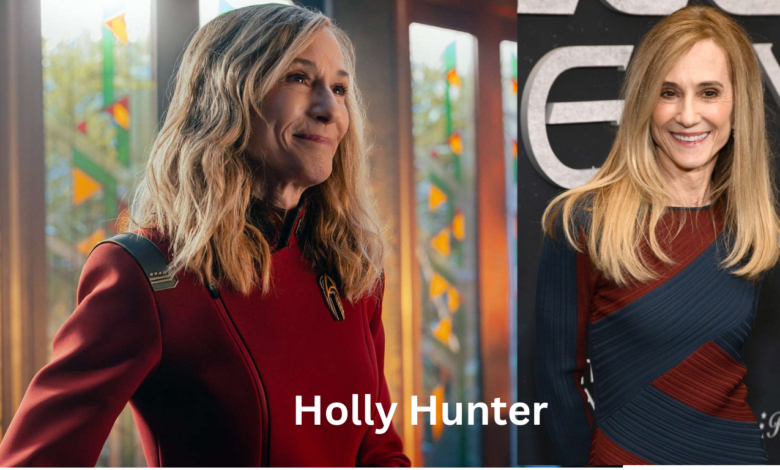
Holly Hunter There are actors who are good at their jobs, and then there are actors who make you forget you’re watching a performance at all. Holly Hunter belongs firmly in the second category. Over a career that has stretched more than four decades, she has built a body of work that is as diverse as it is consistently extraordinary — moving between film, television, and stage with a command and fearlessness that very few performers ever achieve. She is one of those rare talents who elevates every project she touches, regardless of its scale or genre.
Holly Hunter has built a respected acting career through memorable performances across film and television, showcasing her versatility and distinctive screen presence. Her dedication to the craft and ability to bring depth to complex characters have helped establish a lasting legacy in H
From a small farm in Georgia to the Academy Awards stage, the journey of Holly Hunter is one of the most compelling stories in American entertainment. It’s a story built on relentless preparation, quiet intensity, and an almost supernatural ability to inhabit characters from the inside out. If you don’t already know her work deeply, this is your entry point. And if you do know it, you’ll find plenty here worth revisiting.
Early Life and the Making of a Performer
Holly Hunter was born on March 20, 1958, in Conyers, Georgia, the youngest of seven children in a large, close-knit Southern family. Her father ran a 250-acre farm alongside other work, and her mother was a homemaker. Growing up as the baby of a large family on a working farm in the American South gave Holly a grounded, no-nonsense quality that would later become one of the most distinctive features of her on-screen presence. There was nothing manufactured or performative about her upbringing — she came from a world where you showed up, did the work, and didn’t make a fuss about it.
Her passion for acting surfaced early and was actively encouraged by her family. She performed as Helen Keller in a fifth-grade play and went on to participate in local theater productions through high school, including roles in Oklahoma! and Fiddler on the Roof at Rockdale County High School. What’s notable about that early role choice — Helen Keller, a character defined by the absence of conventional communication — is how perfectly it foreshadowed where Holly Hunter career would eventually take her. Even as a child, she was gravitating toward characters that demanded everything from a performer.
One detail from her childhood that adds a quietly remarkable dimension to her story: Holly Hunter lost hearing in her left ear after contracting mumps as a young child, a challenge she adapted to throughout her entire career. She went on to earn her Bachelor of Fine Arts in drama from Carnegie Mellon University in 1980, one of the most rigorous and respected acting programs in the country. It was there that she developed the technical foundation and disciplined work ethic that would serve her without exception for the next four-plus decades.
The New York Years and the Relationships That Changed Everything

After graduating from Carnegie Mellon, Holly Hunter did what serious actors do — she moved to New York City and started building her career from the ground up. She roomed with fellow actress Frances McDormand, a friendship and creative kinship that would prove historically significant for American cinema in ways neither of them could have anticipated at the time.
In New York, Holly Hunter met playwright Beth Henley in what has since become one of the most serendipitous origin stories in modern American theater — the two women were trapped together in a stalled elevator. That chance ten-minute encounter led to a meaningful creative relationship. went on to appear in several of Henley’s Southern Gothic plays, including Crimes of the Heart and The Miss Firecracker Contest, building a stage reputation that opened doors to increasingly serious film opportunities and established her as a performer of genuine theatrical depth.
One of the more fascinating footnotes of this period involves the Coen Brothers. Holly Hunter was offered the lead role in Blood Simple in 1984 but turned it down. Rather than simply passing on the opportunity, she introduced the Coens to her roommate Frances McDormand, who got the role and ultimately married one of the brothers. It’s a decision that sounds costly in hindsight, but it illustrates something important about Holly Hunter’s character — she was more interested in good work and meaningful relationships than in grabbing every opportunity for herself. That generosity of spirit, combined with extraordinary talent, built her a network of collaborators who would return to work with her again and again throughout her career.
Breakthrough Raising Arizona and Broadcast News
The year 1987 was the year Holly Hunter stopped being a promising stage actress and became a genuine film star. Two films released that same year announced her arrival with a force that left no room for doubt about the scale of her talent.
She landed a starring role in the Coen Brothers’ Raising Arizona, a part that was reportedly written specifically with her in mind. Playing Edwina McDunnough — a fiercely determined woman with an overwhelming desire for a child — Holly Hunter brought comedic precision and emotional authenticity to a wildly stylized film that could easily have collapsed under the weight of its own eccentricity. She grounded it completely, and her performance remains one of the funniest and most genuine in the entire Coen Brothers catalog.
Later that same year, Hunter played news producer Jane Craig in James L. Brooks’s Broadcast News — and everything changed. Jane Craig was brilliant, principled, professionally driven, and emotionally complicated in ways that Hollywood rarely wrote female characters at the time. Holly Hunter played her without softening the edges or making her more broadly likable, and the result was one of the most authentic portrayals of a professional woman in American cinema of that era. The performance earned her nominations for both the Academy Award for Best Actress and the Golden Globe, and a Silver Bear for Best Actress at the Berlin International Film Festival. She reportedly won the role just two days before shooting began, stepping in over several better-known actresses — a detail that says everything about the level of preparedness and instinctive readiness she brings to her craft.
The Piano: A Performance for the Ages
If Broadcast News announced Holly Hunter as a serious film actress, The Piano in 1993 confirmed her as one of the greatest performers of her generation. Directed by New Zealand filmmaker Jane Campion, the film cast Holly Hunter as Ada McGrath, a mute Scottish woman in 19th-century New Zealand who communicates through sign language, written notes, and most powerfully, through the music she plays on her beloved piano.
The role required Holly Hunter to convey an entire inner world, a full spectrum of emotion, desire, grief, and fierce determination — entirely without spoken dialogue. It is one of the most technically and emotionally demanding performances in the history of cinema, and Holly Hunter delivered it with a completeness and conviction that left audiences and critics genuinely astonished. She had been playing piano since childhood, and she performed all of the film’s piano pieces herself, adding another layer of authenticity to an already extraordinary performance.
The recognition was immediate and unambiguous. Hunter won the Academy Award for Best Actress for her role in The Piano, as well as the BAFTA Award for Best Actress and the Cannes Film Festival Award for Best Actress — a sweep of the most prestigious performance awards in the world. What makes the win even more remarkable in context is that she was nominated in the same year for a Supporting Actress Oscar for her role in The Firm — meaning Holly Hunter received two Academy Award nominations in the same year, one of the rarest achievements in Oscar history. The Piano stands as the pinnacle of her film career, a performance so complete and so distinctive that it would define the legacy of most actors forever.
Television Range and a Career That Refused to Stand Still
One of the most admirable qualities of Holly Hunter career is that she has never been content to rest on her laurels or repeat herself. After the extraordinary heights of The Piano, she could easily have positioned herself exclusively as a prestige film actress and lived comfortably in that lane indefinitely. Instead, she consistently sought out new challenges, new formats, and new types of characters.
Her move into television was marked by the same quality and commitment she brought to film. Holly Hunter starred in the legal drama Saving Grace from 2007 to 2010, playing Grace Hanadarko, a hard-drinking, morally complicated Oklahoma City detective grappling with faith, responsibility, and her own self-destructive tendencies. The role earned her a Primetime Emmy Award for Outstanding Lead Actress in a Drama Series and a Golden Globe Award for Best Actress in a Drama Series, confirming that her powers as a performer translated fully to the long-form television format. It was a bold, unglamorous, deeply committed performance that demonstrated Holly Hunter’s complete lack of interest in playing it safe.
She has continued to work prolifically across film and television in the years since, appearing in projects ranging from Incredibles 2, where she voiced the character Elastigirl, to critically acclaimed prestige dramas and independent films. Holly Hunter brings the same seriousness and specificity to a voice role in an animated Pixar film as she does to a raw dramatic performance — which is perhaps the clearest possible demonstration of what makes her genuinely exceptional as a performer. The work is always the priority, regardless of the medium or the scale of the project.
What Makes Holly Hunter Genuinely Different
It’s worth pausing to articulate what actually separates Holly Hunter from the enormous pool of talented actors working in American film and television. Because talent alone doesn’t fully explain it. Hollywood is full of talented people. What Holly Hunter has is something rarer and harder to manufacture.
Part of it is her physical presence and the way she uses it. Holly Hunter is not a tall actress, and she has never relied on conventional leading-lady aesthetics to carry a performance. Instead, she communicates through extraordinary physical specificity — the set of her jaw, the angle of her body, the quality of her stillness. She is one of the most physically intelligent actors working, in the tradition of the great stage-trained performers who understand that the body tells as much of the story as the words do.
Part of it is also her absolute refusal to make characters easier or more sympathetic than the truth of the role demands. Holly Hunter plays difficult women — women who are prickly, driven, morally ambiguous, emotionally withholding, or simply operating on a frequency that most people around them can’t quite tune into. She doesn’t sand down those edges to make the audience more comfortable. She trusts the audience to stay with a complicated character, and more often than not, they do — because her commitment to the truth of the performance creates a kind of magnetic pull that is very hard to look away from.
The Legacy of Holly Hunter
Holly Hunter’s legacy in American cinema and television is already secure, and it continues to grow with each new project she takes on. She is one of a small group of performers — perhaps a dozen in any generation — who have genuinely expanded the understanding of what screen acting can do and what female characters can be.
Her influence on younger generations of actresses is real and documented. The example she set — of taking on challenging, unconventional roles without compromise, of bringing complete technical and emotional commitment to every performance regardless of the project’s profile, of building a career on artistic integrity rather than commercial calculation — is one that many actors working today have cited as formative and inspiring.
Holly Hunter has won the Academy Award, the Emmy, the Golden Globe, the BAFTA, and the Cannes award — a collection of honors that reflects not a single brilliant moment but a career of sustained, exceptional work across multiple decades and formats. That kind of longevity is rare. That kind of consistent quality is rarer still. And that combination, in a single performer, is something very close to extraordinary.