Linear Function Explained A Complete Guide to Understanding One of the Most Important

Linear Function Mathematics is full of concepts that help us describe patterns and relationships in the world around us. One of the most fundamental and widely used ideas in mathematics is the linear function. Whether you are studying algebra in school, analyzing data in business, or solving scientific problems, play an important role in understanding how quantities change over time.
A linear function is one of the simplest types of mathematical relationships. It describes a straight-line relationship between two variables, meaning that when one variable changes, the other changes at a constant rate. Because of this predictable behavior, are used in many fields, including economics, physics, engineering, and computer science.
In this article, we will explore what a linear function is, how it works, why it is important, how to identify it, and where it appears in real-life situations. By the end, you will have a clear understanding of why this concept is such a powerful tool in mathematics and beyond.
What Is a Linear Function
A linear function is a mathematical expression that represents a straight-line relationship between two variables. It is usually written in the form:
y = mx + b
In this equation, x represents the independent variable and y represents the dependent variable. The letter m stands for the slope, which tells us how steep the line is, while b represents the y-intercept, which is the point where the line crosses the vertical axis.
The key characteristic of a linear function is that the rate of change between the variables remains constant. This means that if the value of x increases by a certain amount, the value of y will always increase or decrease by the same proportion.
For example, if a function has a slope of 2, it means that for every increase of 1 in x, the value of y increases by 2. This constant rate of change makes functions predictable and easy to analyze compared to more complex mathematical relationships.
Understanding the Components of a Linear Function
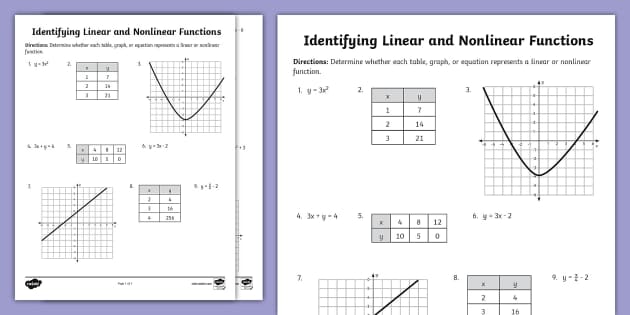
To fully understand a Linear Function, it is important to break down its components. The first component is the slope, which describes the direction and steepness of the line. A positive slope means the line rises from left to right, while a negative slope means it falls.
The second important component is the y-intercept. This is the value of y when x equals zero. In other words, it represents the starting point of the line on a graph. The y-intercept helps determine where the line begins before any changes in x occur.
Another important concept is the rate of change. In linear functions, the rate of change is always constant. This means that the relationship between the variables does not curve or fluctuate. Instead, it forms a straight line when graphed on a coordinate plane.
These components work together to create a simple yet powerful mathematical model that can represent many real-world situations.
Graphing a Linear Function
One of the easiest ways to understand a linear function is by visualizing it on a graph. When plotted on a coordinate plane, a linear always forms a straight line. This visual representation makes it easier to see how the variables interact with each other.
To graph a linear function, you usually start by identifying the y-intercept. This point is placed on the vertical axis. Once the starting point is plotted, the slope is used to determine the direction and steepness of the line.
For example, if the slope is 3, the line will rise three units vertically for every one unit it moves horizontally. By repeating this pattern, multiple points can be plotted, and a straight line can be drawn through them.
Graphing linear is an essential skill in mathematics because it allows students and professionals to quickly interpret relationships between variables. Visual graphs make it easier to identify trends, make predictions, and analyze patterns.
Real-Life Applications of Linear Functions
Although linear functions may seem like an abstract mathematical idea, they appear frequently in everyday life. Many real-world relationships can be described using linear equations because they involve consistent rates of change.
One common example is calculating earnings based on hourly wages. If someone earns a fixed amount of money per hour, their total income increases at a constant rate as they work more hours. This relationship can easily be represented by a linear function.
Another example can be found in transportation. If a car travels at a constant speed, the distance it covers increases steadily over time. This predictable relationship between distance and time can also be modeled using a linear.
Businesses also use linear functions to analyze costs and profits. For instance, if producing each item costs a fixed amount, the total cost increases proportionally with the number of items produced. These simple yet powerful models help companies plan budgets and forecast financial outcomes.
How Linear Functions Help in Problem Solving
One of the greatest strengths of linear functions is their usefulness in problem solving. Because they describe consistent relationships, they allow mathematicians and analysts to predict outcomes with relative accuracy.
For example, if a company knows how much revenue it generates per unit sold, it can use a linear function to estimate total earnings for different production levels. This helps businesses make strategic decisions about pricing and manufacturing.
In science, are often used to describe relationships between variables that change at steady rates. Scientists may analyze experimental data and create linear models to identify trends or confirm hypotheses.
Students also benefit from learning about linear functions because they form the foundation for more advanced mathematical topics. Understanding linear relationships helps prepare learners for algebra, calculus, statistics, and many other fields.
Linear Function Compared to Other Types of Functions
While linear functions are important, they are not the only type of mathematical relationship. Other functions, such as quadratic, exponential, and logarithmic functions, describe more complex patterns.
The key difference is that linear have a constant rate of change, which results in a straight-line graph. In contrast, quadratic functions create curved graphs known as parabolas, while exponential functions grow or decrease rapidly over time.
Because linear functions are simpler, they are often used as a starting point for analyzing data. In many cases, complex relationships can be approximated by linear models within certain ranges.
Understanding the differences between these functions helps mathematicians choose the most appropriate model for a particular situation.
Why Linear Functions Are Fundamental in Mathematics
Linear functions are considered one of the building blocks of mathematics. Many advanced mathematical theories rely on concepts that originate from linear relationships.
For example, systems of linear equations are used to solve problems involving multiple variables. Linear algebra, a branch of mathematics built around linear function, is essential in computer science, physics, engineering, and economics.
Additionally, many statistical techniques rely on linear models to analyze relationships between variables. These models help researchers interpret data, identify trends, and make predictions.
Because of their simplicity and versatility, linear functions remain one of the most widely used tools in both academic and professional settings.
Conclusion The Importance of Understanding Linear Functions
Linear functions may appear simple at first glance, but they hold tremendous importance in mathematics and real-world applications. Their ability to represent consistent relationships makes them valuable tools for solving problems, analyzing data, and predicting outcomes.
From calculating wages and travel distances to modeling scientific experiments and business operations, linear functions help people understand how different quantities interact. Their straightforward structure also makes them an ideal starting point for learning more complex mathematical concepts.
By mastering students and professionals gain a deeper appreciation for how mathematics describes the patterns and relationships that shape our everyday lives.