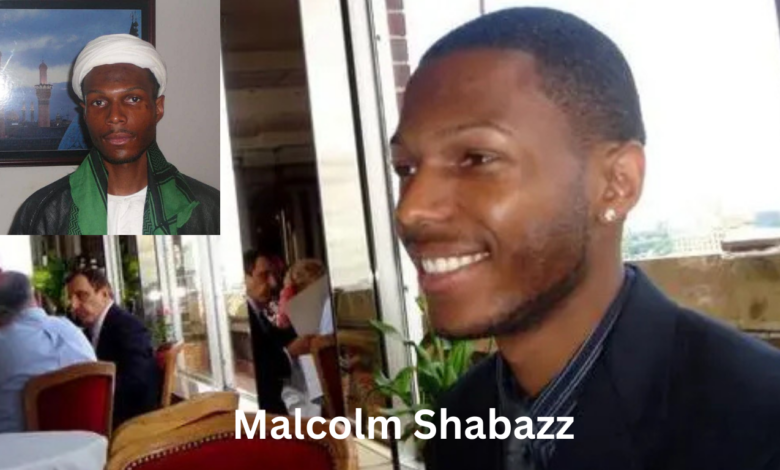
Malcolm Shabazz There are lives that seem to carry the full weight of history on their shoulders from the very moment they begin. was one of those people. Born into one of the most powerful and consequential legacies in African American history, he was the grandson of Malcolm X — one of the most influential and transformative figures in the history of civil rights in America. But the story of Malcolm Shabazz wasn’t a polished continuation of that legendary legacy. It was raw, painful, complicated, and ultimately, deeply human.
His life moved through tragedy, incarceration, spiritual awakening, and a genuine search for purpose and redemption. While media coverage of Malcolm tended to fixate on his darkest chapters, the fuller picture of who he was and who he was actively becoming in the final years of his short life deserves to be told with the honesty and depth it merits.
Early Life: Born Into a Legacy He Never Asked For
Malcolm Latif Shabazz was born on October 8, 1984, in Paris, France. His mother, Qubilah Shabazz, was the second daughter of Malcolm X and Betty Shabazz, making Malcolm Shabazz the direct grandson of one of the most celebrated and debated figures in American political history. His father was an Algerian Muslim, and by most accounts, Malcolm Shabazz never had a meaningful relationship with him growing up.
From the earliest years of his life, Malcolm Shabazz experienced a level of instability that would have challenged any child. His mother faced significant personal and legal difficulties, and Malcolm moved frequently — between cities, between family members, between periods of structured care and total absence of supervision. He spent time in foster care and bounced through living situations that offered little of the consistency, warmth, and guidance that children require to develop a stable sense of self. The chaos of those formative years left marks that would surface repeatedly throughout his adolescence and early adulthood.
What makes the childhood of Shabazz particularly poignant is that the deprivation wasn’t purely material. It was emotional and relational. He grew up carrying the name and the shadow of a grandfather he never knew, surrounded by the weight of public expectation and historical significance, while simultaneously lacking the basic parental presence and stability that ordinary children take for granted. That contradiction — being historically significant and personally neglected at the same time — created a kind of internal fracture that Malcolm Shabazz spent most of his life trying to heal.
The Tragedy of 1997 and Its Lasting Impact

No honest account of Malcolm Shabazz can avoid the defining event of his early life — one that shaped public perception of him for years and that he himself carried as an enormous personal burden for the rest of his days. In the summer of 1997, when Malcolm Shabazz was just twelve years old, he set a fire in the apartment of his grandmother, Betty Shabazz, the widow of Malcolm X. Betty Shabazz suffered severe burns over a devastating portion of her body and died from her injuries on June 23, 1997.
The death of Betty Shabazz sent waves of grief through the African American community and across the country. She was not merely a grandmother — she was a civil rights figure in her own right, a woman who had survived the assassination of her husband, raised six daughters largely on her own, built an academic career, and dedicated herself to education and community service. Her loss was felt as a collective one, and the circumstances surrounding it placed the twelve-year-old the center of a story far larger and more painful than any child should ever have to inhabit.
Malcolm Shabazz pleaded guilty and was placed in juvenile detention. By all accounts, he expressed deep remorse for what had happened and struggled enormously with guilt in the years that followed. He reportedly prayed for forgiveness from his grandmother, desperately wanting her to know that he was sorry. His defense maintained throughout proceedings that the fire was not an act of deliberate harm but the desperate, uncontrolled expression of a profoundly troubled child who had never received adequate care, mental health support, or emotional guidance. Understanding Malcolm Shabazz requires holding both truths simultaneously — the real pain his actions caused and the real pain that preceded them.
A Cycle of Incarceration and the Search for Stability
Following his release from juvenile detention, Malcolm Shabazz struggled to find stable footing in the world. The years after his release were marked by repeated brushes with the law, further periods of incarceration, and a painful cycling in and out of the criminal justice system that seemed to reflect both his ongoing personal struggles and the broader failures of a system that rarely succeeds in rehabilitating the people it processes.
He was arrested in 2002 for a robbery-related offense and sentenced to several years in prison. Further arrests followed in the years after that release. Each return to incarceration represented not just a personal setback for Malcolm but a continuation of a pattern that seemed almost predetermined by the circumstances of his childhood — the instability, the absence of consistent mentorship, the lack of mental health support, and the weight of a public identity that offered no room for the ordinary, messy process of growing up and making mistakes.
What is important to understand about this period of Malcolm Shabazz’s life is that it was not simply a story of personal failure. It was a story that illustrated, with painful clarity, what happens when children who experience trauma, neglect, and instability are processed through a justice system rather than supported through a care system. Shabazz was not the only young person with his background to end up in that cycle. He was simply the one doing it under the most public, historically loaded name imaginable.
Spiritual Awakening and Following His Grandfather’s Path
One of the most meaningful and underreported dimensions of the Malcolm Shabazz story is his genuine spiritual awakening and his deep engagement with Islam, which mirrored in striking ways the spiritual transformation that had defined his grandfather’s life decades earlier. Just as Malcolm X had found in Islam a framework for understanding himself, his identity, and his place in the struggle for justice and dignity, Malcolm Shabazz found in his faith a path toward healing and purpose.
By his mid-twenties, had begun seriously engaging with his Islamic faith, studying its history and teachings with real commitment and growing deeper in his understanding of what it meant to live according to its principles. He spoke publicly about the role of faith in his personal transformation and about the parallel he saw between his own journey and that of his grandfather — both men having gone through periods of darkness and destructive behavior before finding in Islam a source of discipline, meaning, and direction.
Malcolm Shabazz also began actively engaging with his grandfather’s intellectual and political legacy in a more deliberate way. He started speaking at events, participating in discussions about race, justice, and the African American experience, and positioning himself as someone who had something genuine to contribute to those conversations — not simply because of his name, but because of what he had lived through and learned from it. The transformation was real and witnessed by those who knew him. He was not performing redemption. He was working toward it with visible sincerity and growing clarity.
Malcolm Shabazz as an Emerging Voice
In the final years of his life, Malcolm Shabazz was increasingly visible as a public figure and emerging activist voice. He traveled internationally, spoke at universities and community events, and engaged seriously with political and social issues ranging from mass incarceration to the African diaspora to the ongoing relevance of his grandfather’s message in the 21st century context.
He was articulate, thoughtful, and self-aware in ways that surprised people who knew him only through the headlines about his troubled past. Those who met Malcolm Shabazz in his later years often described someone who had done genuine, difficult internal work — who had looked honestly at his own history, taken real responsibility for the harm he had caused, and was actively working to build something meaningful out of the wreckage of his earlier years. He spoke about his grandmother not with avoidance but with grief, love, and a desire to honor her memory through the direction of his life.
Malcolm Shabazz also spoke candidly about the criminal justice system, about what it felt like to grow up without a father, about the particular difficulty of carrying a historically significant name while struggling privately with very ordinary human pain. Those conversations were important. They humanized a figure that the media had long reduced to a single tragic moment, and they pointed toward the kind of voice he might have developed had he been given more time.
The Death of Malcolm Shabazz
Tragically, Malcolm Shabazz never got the time he needed to fully realize the potential that those who knew him in his final years clearly saw. On May 9, 2013, died in Mexico City under violent circumstances. He was just twenty-eight years old. The news of his death sent shock and grief through activist communities and among those who had followed his journey and believed in his emerging purpose.
The circumstances surrounding his death were murky and disputed, and questions about what exactly happened that night in Mexico City lingered for years afterward. What was undisputed was the profound sense of loss that his death represented — not just for his family, who had already endured more grief than most families ever face, but for a community that had watched him fighting to become something and had begun to believe he just might get there.
Malcolm Shabazz died at the same age that his grandfather was already in the thick of his most transformative and influential work. The parallel is both striking and heartbreaking. Given more years, more safety, more stability — it is genuinely impossible to know what Malcolm Shabazz might have built, said, or contributed.
The Legacy of Malcolm Shabazz
The legacy of Malcolm Shabazz is not a simple one, and it would be dishonest to package it as a straightforward redemption narrative. It is a complicated, layered story about the long reach of trauma, the weight of inherited identity, the failures of systems meant to protect and rehabilitate, and the extraordinary human capacity for growth even under the most difficult circumstances.
Malcolm Shabazz forces us to ask uncomfortable questions. About what we owe children who are failed by the adults and institutions responsible for their care. About how the criminal justice system shapes or destroys the trajectories of young people who enter it. About what genuine redemption looks like and whether society is willing to make room for it. About the distance between a person’s worst moment and the full truth of who they are.
What remains clear is that Malcolm Shabazz, for all the darkness in his story, was a person of real depth, real remorse, real faith, and real ambition. He deserved more time. He deserved more support far earlier in his life. And his story, told fully and honestly, has things to teach us that go well beyond the headlines that defined how most people knew his name.