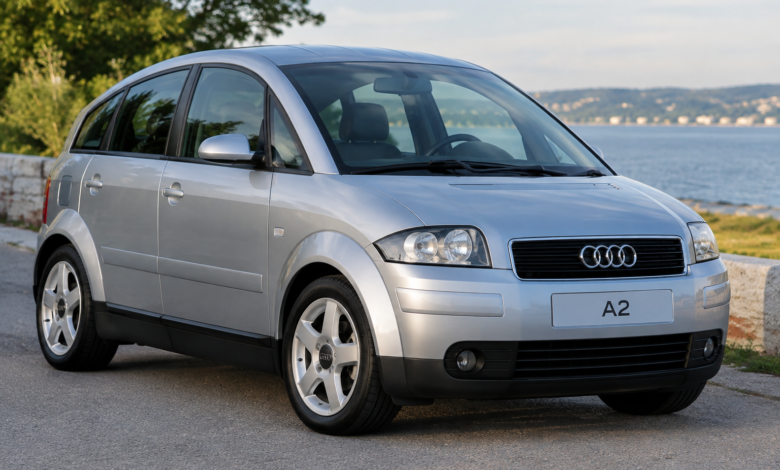
Audi A2 is one of those cars that becomes more interesting the more you learn about it. At first glance, it looks like a small practical hatchback from the early 2000s. Look closer, though, and the engineering story is much more unusual. Audi built the A2 around lightweight construction, clever packaging, aerodynamics, and fuel efficiency at a time when most small cars were still relying heavily on conventional steel construction.
Audi introduced the production A2 in 1999, and the model reached the market in 2000. Its most distinctive feature was an aluminum Audi Space Frame structure, which helped keep weight down while providing a surprisingly roomy cabin for such a compact vehicle. Audi says the car measured about 3.83 meters long, 1.67 meters wide, and 1.55 meters high.
The car was never a huge commercial success, and production ended in 2005. Yet that did not erase its importance. In fact, decades later, the Audi A2 has developed a dedicated following among people who appreciate unusual engineering and efficient everyday cars. Audi itself now describes the model as having a second career as a modern classic.
How the Audi A2 Came to Life
The story of the Audi A2 began before the production car appeared in showrooms. Audi was working on the idea of a highly efficient compact car during the 1990s, with lightweight construction playing a central role. The early project eventually produced the AL2 concept, which was shown at the Frankfurt Motor Show in 1997.
What makes that concept particularly interesting is how much of its thinking survived into the production model. Instead of turning the concept into a conventional small hatchback, Audi kept much of its distinctive shape and engineering philosophy. The result was a car that looked different from many of its rivals before it even moved.
Audi officially unveiled the production version at the Frankfurt Motor Show in September 1999. Production facilities were established at Neckarsulm, Germany, and the company developed specific manufacturing processes for the aluminum-intensive vehicle.
That approach required considerable engineering effort. Audi was not simply putting aluminum body panels on an ordinary small-car platform. The structure itself was designed around the Audi Space Frame concept, which became one of the defining characteristics of the model.
Why the Aluminum Body Was So Important
The aluminum construction is arguably the biggest reason the Audi A2 remains interesting today. Audi stated that the A2 was the first volume-production compact car with a body made entirely from aluminum. Its body shell, including the doors and tailgate, weighed around 153 kilograms.
The benefit of reducing weight goes beyond simply making a car easier to move. A lighter vehicle generally requires less energy to accelerate and can also place less demand on components such as brakes, tires, and suspension. Audi used this philosophy throughout the A2 rather than treating lightweight construction as a single feature.
The aluminum structure also helped give the Audi A2 its distinctive identity. Audi had already demonstrated aluminum space-frame technology with larger models, but applying that thinking to a compact hatchback was a much more unusual proposition. It showed that lightweight engineering could be used for an everyday family-oriented vehicle rather than only for an expensive performance car.
Audi A2 Engine Choices and Efficiency
During its production run, the Audi A2 was offered with several engine options. Audi’s historical records list two gasoline engines and three diesel variants across the model’s lifespan. These included the 1.4-liter gasoline engine, 1.4 TDI versions, the 1.2 TDI, and the later 1.6-liter FSI gasoline engine.
The 1.4-liter gasoline model produced 75 PS, while the original 1.4 TDI also produced 75 PS. The diesel engine used three-cylinder technology with direct injection, giving the compact hatchback a distinctive combination of small dimensions and strong low-speed efficiency.
For drivers who wanted more performance, Audi A2 eventually introduced the 1.6-liter FSI. With 110 PS, it was considerably more powerful than the basic versions. Audi says this engine could take the car beyond 200 km/h, making the A2 considerably more capable than its unusual shape might suggest.
The Remarkable Audi A2 1.2 TDI
The Audi A2 1.2 TDI deserves its own discussion because it pushed the efficiency concept much further than the standard versions. Audi introduced this variant with a strong focus on reducing fuel consumption and weight.
According to Audi, the 1.2 TDI produced 61 PS and was rated at just 2.99 liters of diesel per 100 kilometers. It also used additional lightweight components and aerodynamic improvements, bringing its curb weight down to approximately 855 kilograms.
Aerodynamics played a major role as well. Audi reports that the 1.2 TDI achieved a drag coefficient of 0.25, compared with 0.28 for the standard A2. Narrower tires, aerodynamic wheel designs, underbody treatment, and revised airflow management all contributed to the result.
The 1.2 TDI became particularly notable because Audi A2 described it as the world’s first four-door three-liter car. In an era when fuel economy was becoming increasingly important, that figure demonstrated what could happen when weight, aerodynamics, and engine efficiency were developed together rather than separately.
What the Audi A2 Is Like Inside
From the outside, the Audi A2 is compact, but its interior packaging is one of the reasons the car developed such a loyal following. Audi designed the body to provide useful passenger space without making the vehicle physically large.
The relatively tall roofline helps create a more spacious feeling than the car’s exterior dimensions might suggest. This was a practical design decision rather than simply a styling trick. The result is a cabin that can feel more accommodating than people unfamiliar with the car might expect.
The interior also reflects the period in which the car was developed. There are straightforward controls, durable materials, and a functional layout rather than the enormous screens and digital interfaces found in modern vehicles. For some drivers, that simplicity is part of the appeal.
Design That Still Looks Different
Styling has always been a major part of the Audi A2 conversation. The shape is neither a conventional hatchback nor a traditional small MPV. Its tall body, short overhangs, curved roof, and compact footprint give it a character that remains easy to recognize.
The design was deliberately aerodynamic. Audi’s engineers wanted the car to move efficiently through the air, and the exterior shape reflects that priority. The smooth surfaces and upright cabin were not designed simply to follow fashion trends of the period.
There was also an element of experimentation in the color choices. In 2003, Audi introduced the “colour.storm” specification with bold finishes including Imola Yellow, Misano Red, and Sprint Blue, combined with contrasting black exterior details.
Why Production of the Audi A2 Ended
Despite its clever engineering, the Audi A2 did not achieve the level of sales Audi had originally expected. Production ended in 2005, with Audi reporting a total of 176,377 examples built at Neckarsulm.
One obvious challenge was cost. Building a lightweight aluminum structure using specialized production methods was considerably more complicated than producing a conventional small steel hatchback. Customers shopping in the compact-car market were not necessarily willing to pay extra for engineering advantages that were not immediately visible.
There was also the question of timing. The A2 was designed around efficiency and lightweight construction before those themes became as prominent in mainstream automotive marketing as they are today. Audi itself has since described the car as having been ahead of its time in its approach to economy and technology.
Is the Audi A2 Still Relevant Today?
Looking at the Audi A2 today is interesting because many of its core ideas remain relevant. Lightweight construction, aerodynamic efficiency, compact dimensions, and sensible use of interior space are all concepts that modern manufacturers continue to explore.
Of course, an early-2000s compact car cannot compete directly with a modern vehicle for every feature. Newer cars generally offer more advanced safety systems, connectivity, driver assistance technology, and updated powertrains. The A2’s appeal is therefore less about matching a new car feature for feature and more about appreciating what Audi attempted with the technology available at the time.
That distinction matters when considering one as a used vehicle. A well-maintained example can be interesting and economical, but age means condition is just as important as the badge on the bonnet. Buyers should pay attention to service history, mechanical condition, suspension components, electrical equipment, and the condition of the aluminum body structure.
What Makes the Audi A2 a Modern Classic?
There is a reason enthusiasts continue talking about the Audi A2 more than two decades after production ended. It combines a distinctive design with an engineering philosophy that was genuinely unusual for its class.
Audi itself says the model still has a loyal fan base and can be used as an everyday vehicle today. The company’s historical review also highlights its qualities as an economical and practical companion.
The limited production numbers add another layer of interest. Audi built 81,649 examples of the 1.4 gasoline model, 69,676 of the 1.4 TDI, 7,416 of the 90 PS 1.4 TDI, 11,081 of the 1.6 FSI, and just 6,555 examples of the 1.2 TDI according to its 2025 historical figures.
That production breakdown explains why certain versions are much less common than others. The 1.2 TDI, in particular, represents a relatively small part of total A2 production, which makes surviving examples especially interesting to enthusiasts who focus on the model’s efficiency story.
Final Thoughts on the Audi A2
The Audi A2 was never simply another small hatchback. From its aluminum structure to its aerodynamic shape and unusually efficient engines, Audi approached the project with a level of engineering ambition that was unusual for a compact car.
Production lasted only from around 2000 to 2005, but the ideas behind the car have aged surprisingly well. Audi’s own 25-year retrospective highlights its lightweight construction, efficiency, compact dimensions, and continuing enthusiast following.
Today, the A2 is best understood as an unconventional piece of automotive history. It may not have achieved the commercial success Audi originally wanted, but its combination of technology, practicality, and distinctive design helped it develop a character that many ordinary hatchbacks never achieved.
For anyone interested in cars that tried something genuinely different, the A2 remains worth remembering. It is a good example of how an ambitious idea can outlive its original market position and eventually gain appreciation from a new generation of enthusiasts.