Linear Function is one of the most fundamental ideas in mathematics, yet it shows up in surprisingly practical ways. At its core, a linear function describes a relationship between two variables where the change is constant. In simple terms, when one variable increases, the other changes at a steady rate.
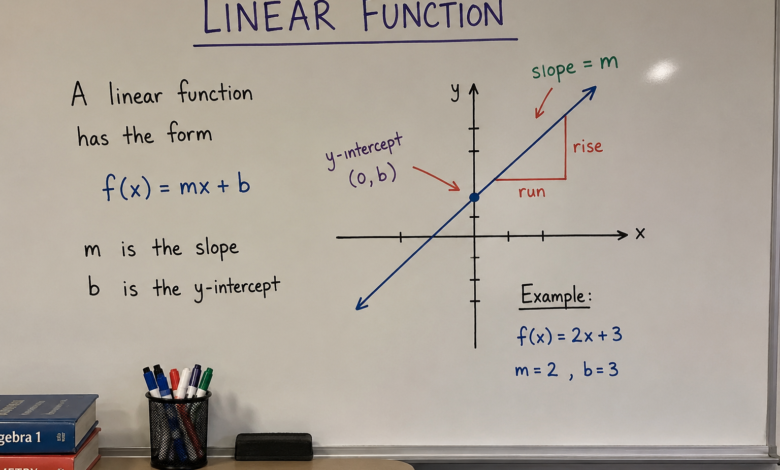
Most commonly, a is written in the form y = mx + b, where m represents the slope and b is the y-intercept. This equation might look basic, but it carries powerful meaning. It tells you how steep a line is and where it crosses the vertical axis, making it easy to predict values.
What makes the especially interesting is its simplicity. Unlike complex equations, it behaves predictably. Whether you’re solving math problems or analyzing real-world trends, this consistency is what makes the linear function so widely used.
Understanding the Components of a Function
To truly grasp a linear function, you need to understand its key components. The slope, often represented by m, tells you how fast the output changes. A positive slope means the line goes upward, while a negative slope shows a downward trend.
The y-intercept, labeled as b, indicates where the line crosses the y-axis. This is the starting point of the when the input value is zero. It provides a reference that helps you understand the function’s behavior right from the beginning.
Another important aspect is the variables themselves. Typically, x is the independent variable, and y is the dependent one. The relationship between these variables defines the linear function, making it easier to model situations where one factor influences another in a consistent way.
Graphing a Linear Step by Step

Visualizing a Linear Function becomes much easier when you graph it. The process usually starts by identifying the y-intercept and plotting that point on the graph. From there, you use the slope to determine the direction and steepness of the line.
For example, if the slope is 2, you move up two units for every one unit you go to the right. This step-by-step movement helps you plot additional points. Once you have at least two points, you can draw a straight line through them to represent.
Graphing also helps reveal patterns. You can instantly see whether the function is increasing or decreasing. This visual clarity is one of the reasons why the linear function is often introduced early in math education—it builds intuition quickly.
Real-Life Applications of Linear Function
The isn’t just a classroom concept; it has real-world applications everywhere. For instance, calculating distance based on speed and time often involves a linear relationship. If you travel at a constant speed, the distance increases steadily over time.
Businesses also rely on linear function models. Profit calculations, cost analysis, and revenue projections often use linear equations. These models help decision-makers predict outcomes and plan strategies with confidence.
Even in everyday life, the plays a role. Think about budgeting or tracking expenses. If you spend a fixed amount daily, your total expenses follow a linear pattern. Recognizing these patterns can help you make smarter financial decisions.
Differences Between Linear and Nonlinear
While the straightforward, not all functions behave this way. involve curves, meaning the rate of change is not constant. This makes them more complex and harder to predict compared to a linear function.
One key difference lies in the graph. A always produces a straight line, while non create curves or irregular shapes. This visual distinction makes it easy to identify the type of function you’re dealing with.
Another difference is predictability. once you know the slope, you can easily estimate future values. Nonlinear functions require more detailed calculations, which is why linear models are often preferred for simple analysis.
Common Mistakes When Working with Linear Function
Even though the linear function is simple, mistakes can still happen. One common error is misinterpreting the slope. A small mistake in the slope value can completely change the direction or steepness of the line.
Another issue is confusing the y-intercept with other points on the graph. The y-intercept specifically refers to where the line crosses the y-axis, not just any point. Misplacing this can lead to incorrect graphs.
Students also sometimes forget that a must have a constant rate of change. If the change isn’t consistent, then it’s not truly a linear function. Keeping this definition in mind helps avoid confusion.
How Linear Builds Mathematical Thinking
Learning about the does more than just teach equations—it builds logical thinking. It trains you to recognize patterns, analyze relationships, and make predictions based on data.
This concept also serves as a foundation for more advanced math topics. Algebra, calculus, and even statistics rely heavily on understanding linear relationships. Mastering the linear function makes these subjects easier to approach.
Beyond academics, the skills gained from studying are highly practical. Problem-solving, critical thinking, and data interpretation are all enhanced through this concept, making it valuable in many fields.
Tips to Master Linear Quickly
If you want to get comfortable with the linear function, practice is key. Start by solving simple equations and gradually move to more complex problems. This step-by-step approach helps build confidence.
Another effective strategy is to visualize problems. Drawing graphs and identifying slopes can make abstract concepts more concrete. The more you interact with the visually, the better you understand it.
Finally, connect the concept to real-life scenarios. When you see how the linear function applies outside the classroom, it becomes easier to remember and use. This practical connection reinforces learning in a natural way.
Final Thoughts on Linear Function
The linear function may seem basic at first glance, but its impact is far-reaching. From simple calculations to complex modeling, it provides a reliable framework for understanding relationships between variables.
Its strength lies in its clarity. With just a simple equation, you can describe patterns, make predictions, and solve problems efficiently. This makes the one of the most useful tools in mathematics.
In the end, mastering the linear function isn’t just about math—it’s about thinking clearly and logically. Once you understand it, you’ll start noticing its presence in many aspects of daily life, making it a skill worth developing.