
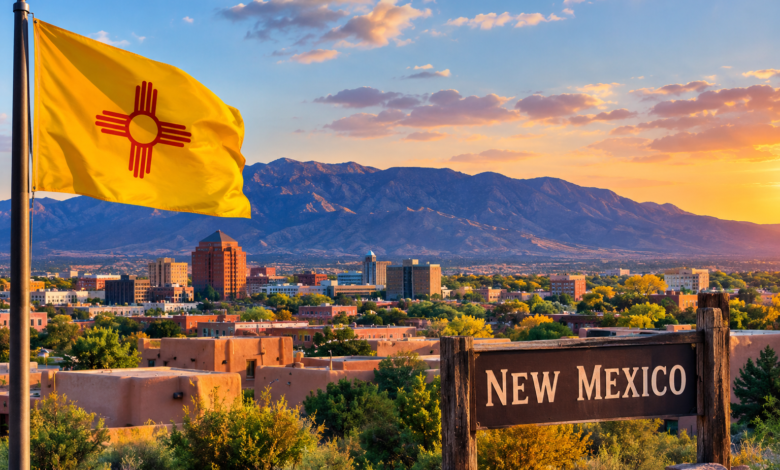
New Mexico is one of those places that becomes more interesting the longer you look at it. At first glance, it may seem like a state defined by deserts, mountains, and wide-open roads. Spend a little more time exploring, however, and a much richer picture appears. Ancient Indigenous traditions, Spanish and Mexican influences, modern American culture, art, science, food, and outdoor adventure all exist side by side.
Known as the “Land of Enchantment,” the state offers a landscape that changes dramatically from one region to another. Visitors can move from high mountain forests to dry desert, colourful badlands, fertile river valleys, and enormous white gypsum dunes without leaving the state. New Mexico is also the fifth-largest U.S. state by land area.
What makes New Mexico especially distinctive is that its identity cannot be reduced to scenery. Its food, architecture, languages, art, communities, and history are just as important. Whether someone is planning a road trip, researching American geography, or simply trying to understand why the state has such a strong personality, there is plenty to discover.
What Makes New Mexico So Different?
One reason New Mexico stands apart is the combination of cultures that have shaped the region over centuries. Indigenous communities have lived in the area for thousands of years, while Spanish influence dates back to the late 1500s. Later came Mexican rule and eventually U.S. territorial and statehood periods. Each era left something behind.
You can see those influences in everyday life. Adobe buildings, Native American artwork, Spanish traditions, Mexican flavours, modern American businesses, and regional festivals all contribute to the character of the state. It is not a culture created from one historical period; instead, it developed through layers of different communities and experiences.
That mixture also explains why travelling through New Mexico can feel different from travelling through neighbouring states. The architecture changes, local food has its own personality, and even the colour palette of towns and landscapes seems distinctive. The state feels connected to the broader Southwest while maintaining a character that is unmistakably its own.
The Landscapes of New Mexico

It is easy to imagine New Mexico as nothing more than a hot, dry desert, but that picture is incomplete. The state contains forested mountain ranges, grasslands, mesas, high plateaus, river valleys, volcanic formations, and desert environments. Elevation plays a major role in creating these changes.
The northern part of the state includes portions of the southern Rocky Mountains, including the Sangre de Cristo range. Higher elevations can bring snow, forests, and cooler temperatures, creating a completely different atmosphere from the desert regions farther south.
Then there are places such as White Sands, where brilliant gypsum dunes create a landscape that looks almost unreal. Elsewhere, visitors can explore rocky wilderness areas, deep caverns, volcanic formations, and unusual geological structures. The variety is one of the strongest reasons the state appeals to outdoor enthusiasts.
Santa Fe and the Artistic Side of the State
Santa Fe is one of the most recognisable cities in New Mexico, and its reputation is closely connected with art, architecture, history, and culture. The city has a distinctive adobe-inspired appearance, with warm earth tones and buildings that reflect regional traditions.
Art lovers have plenty to explore. Galleries, museums, markets, studios, and cultural events have helped establish Santa Fe as an important art destination. The city also provides an excellent example of how Indigenous, Spanish, Mexican, and American influences can appear together without completely blending into one uniform style.
There is a slower rhythm to Santa Fe that many visitors appreciate. Instead of feeling like a conventional large American city, it encourages people to walk, browse galleries, try local food, visit historic sites, and spend time looking at the details. That atmosphere is a major part of the city’s appeal.
Albuquerque Brings a Different Energy
If Santa Fe feels artistic and historic, Albuquerque offers a more urban and energetic experience. As the state’s largest city, it serves as an important centre for business, culture, food, entertainment, and outdoor activities.
One of Albuquerque’s most famous events is its annual hot-air balloon gathering. The sight of hundreds of colourful balloons floating above the landscape has become closely associated with the city and attracts visitors from around the world.
Albuquerque also has a strong connection with Southwestern cuisine and Flamenco culture. Its position along historic travel routes has helped give the city a mixture of influences, while the surrounding mountains and desert provide plenty of opportunities for hiking and other outdoor activities.
New Mexico Has Deep Indigenous Heritage
The Indigenous history of New Mexico is one of the most important parts of understanding the state. Numerous Native nations and communities have longstanding connections to the land, and their traditions continue today rather than existing only as historical subjects.
Pueblo communities, the Navajo Nation, Apache communities, and other Indigenous groups contribute to the state’s cultural landscape. Their histories are reflected in architecture, art, ceremonies, food, language, and community traditions.
Places such as Taos Pueblo and Chaco Culture National Historical Park provide opportunities to learn about the region’s ancient and continuing Indigenous heritage. However, visitors should remember that these are living cultures, not simply tourist attractions. Respect for local rules, traditions, photography policies, and community spaces matters when visiting.
Food Is a Major Part of New Mexico’s Identity
Talk about New Mexico for very long and the conversation eventually reaches food. The state’s cuisine has developed its own identity, with chile playing a central role. Red chile and green chile appear in many dishes, and the question of which one is better can become surprisingly serious among locals.
New Mexican food is not simply about making something spicy. The flavour of regional chile can be earthy, smoky, sweet, or hot, depending on the variety and preparation. It is commonly used with enchiladas, burritos, stews, breakfast dishes, burgers, and many other meals.
Food also reflects the state’s cultural history. Indigenous ingredients and techniques, Spanish traditions, Mexican influences, and later American additions have all contributed to what people now recognise as New Mexican cuisine. That makes eating locally an important part of experiencing the state rather than just another travel activity.
White Sands Is One of Its Most Remarkable Places
White Sands is perhaps one of the easiest places to understand why New Mexico has earned its reputation for unusual scenery. Instead of the typical golden or reddish desert sand many people imagine, visitors encounter enormous fields of bright white gypsum dunes.
The landscape changes throughout the day as sunlight moves across the dunes. Early morning and late afternoon can produce particularly striking shadows and textures, while the clean white surface creates a strong contrast with the surrounding desert.
The dunes are also a good reminder that desert environments are not all the same. White Sands has a character of its own, and the experience is less about seeing one dramatic landmark and more about walking through an expansive landscape that feels almost otherworldly.
Carlsbad Caverns Shows Another Side
Far from the bright openness of White Sands, Carlsbad Caverns offers an underground experience. The national park is famous for its enormous cave system and impressive formations created over extremely long periods.
Walking underground changes the way visitors think about the state’s geography. Above ground, the region may appear dry and exposed. Below the surface, however, there is an intricate world shaped by geology, water, minerals, and time.
For travellers who enjoy natural attractions, combining places such as White Sands and Carlsbad Caverns can make a trip especially memorable. The two destinations show just how dramatically the environment can change within the same state.
New Mexico and the Magic of Road Trips
A road trip is one of the best ways to experience New Mexico because the landscape changes so frequently. Long stretches of highway can lead through desert, mountains, small communities, historic towns, and unexpected roadside attractions.
The state has numerous scenic routes, and historic Route 66 remains particularly significant. Travelling through parts of the old highway allows visitors to experience a mixture of classic roadside culture and modern communities.
The open spaces can also make driving feel different from travelling through heavily populated parts of the country. Distances may seem larger, towns can be widely separated, and weather conditions can change with elevation. A little planning therefore goes a long way, especially for people unfamiliar with the Southwest.
The State Has a Strong Connection With Science
Another fascinating side of New Mexico is its relationship with science and technology. The state has long been connected with major research institutions, national laboratories, aerospace activity, and military facilities.
Los Alamos is particularly important in American scientific history because of its role in the Manhattan Project. The state’s high-altitude environments and relatively open spaces have also contributed to its importance in scientific and aerospace research.
This creates an interesting contrast. A place often associated with deserts, pueblos, art markets, and chile also has a significant role in modern scientific research. That combination is part of what makes the state difficult to categorise neatly.
When Is the Best Time to Visit?
The best time to explore New Mexico depends heavily on what you want to do. Spring and autumn are often attractive for road trips because temperatures can be more comfortable than during the hottest part of summer.
Summer can still be enjoyable, particularly in higher mountain areas, although desert locations may become very warm during the day. Higher elevations can offer cooler conditions and different outdoor opportunities.
Winter brings another side of the state, especially in northern mountain communities where skiing and snow activities become possible. Because elevation varies dramatically, checking conditions for individual destinations is more useful than assuming the entire state experiences the same weather.
Why New Mexico Leaves a Lasting Impression
There is something unusually memorable about New Mexico because its appeal comes from several directions at once. The scenery is dramatic, but the cultural history gives that scenery context. The food is distinctive, while the cities provide art, museums, festivals, and modern entertainment.
For some travellers, the biggest attraction may be the mountains. Someone else may remember the quiet of the desert, the architecture of Santa Fe, a plate of green chile, an Indigenous cultural site, or the sight of balloons rising above Albuquerque.
That variety is the real strength of the state. You do not have to choose between history, food, nature, art, science, or adventure. They are all part of the same place.
Final Thoughts on New Mexico
New Mexico is much more than a desert destination. It is a state shaped by ancient Indigenous cultures, centuries of Hispanic influence, American history, striking geography, and a modern creative spirit.
Its landscapes range from snowy mountains to enormous desert spaces, while its communities offer distinctive food, architecture, art, and traditions. Places such as Santa Fe, Albuquerque, Taos, White Sands, and Carlsbad Caverns each reveal a different side of the state.
Perhaps that is why the nickname “Land of Enchantment” has remained so appropriate. The state does not rely on one attraction to impress visitors. Instead, its character comes from the unexpected combination of many things. Once you begin looking beyond the desert stereotype, New Mexico becomes a fascinating destination with a depth that can take far more than one trip to appreciate.





One Comment