
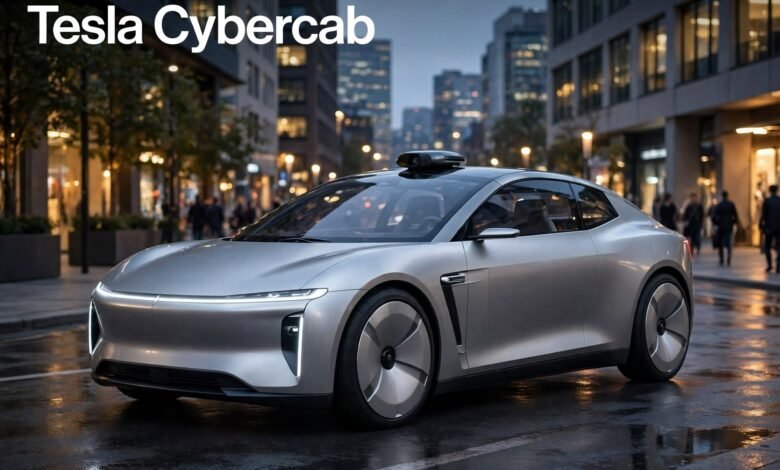
What Is the Tesla Cybercab
Cybercab is an all-electric, purpose-built robotaxi designed to transport passengers without a human driver. It features a two-seat cabin, a steering-wheel-free design and Tesla’s camera-based autonomous driving technology. Tesla has presented it as a future low-cost ride service, but its final price, specifications and availability remain subject to change.
TL;DR
- Purpose: A fully autonomous electric taxi designed for two passengers.
- Expected price: Tesla has discussed a target below $30,000, but the final retail price is not confirmed.
- Release date: Tesla is targeting customer deliveries by the end of 2026, subject to regulatory and production progress.
What Is the Tesla Cybercab and Why Is It Different?
The Tesla Cybercab is not simply another electric car. It has been designed specifically for autonomous transportation, meaning passengers are expected to select their destination and let the vehicle handle the journey.
Its most unusual feature is the absence of a steering wheel. Tesla has also designed the vehicle without conventional pedals and mirrors, creating a cabin focused entirely on passenger use. The company plans to make it an important part of its Robotaxi network.
Unlike a traditional taxi, the Cybercab is intended to operate without a human driver. This could eventually allow Tesla to offer rides through an app while using its own vehicles as part of a shared transportation service.
The concept is ambitious, but its success will depend on more than attractive design. Reliable self-driving software, passenger safety, legal approval and affordable operating costs will all matter.
How Much Will the Tesla Cybercab Cost?

Tesla has previously indicated that the Cybercab could cost less than $30,000. However, this figure should be treated as a target rather than a confirmed purchase price.
Elon Musk presented the under-$30,000 target when Tesla first unveiled the vehicle in October 2024. The company has not published a final consumer price list that confirms what buyers will actually pay.
There is another important detail: Tesla may not sell most Cybercabs to individual drivers. The company has discussed using the vehicles primarily in its own ride-hailing network. Musk has suggested that Tesla will own and operate a large proportion of the fleet.
Tesla’s current support information allows interested businesses to enquire about purchasing individual vehicles or fleets for commercial purposes. That does not mean ordinary retail orders are widely available.
For potential buyers, the sensible approach is to wait for an official price, delivery terms and market-specific availability before making financial plans.
When Will the Tesla Cybercab Be Released?
Tesla has started production of the Cybercab and is targeting customer deliveries by the end of 2026. However, the company has not guaranteed that every interested customer will receive a vehicle during that period.
Tesla’s second-quarter 2026 update confirmed that production had started. The company also reported that engineering test drives of production vehicles had begun on public roads, while employee rides were taking place at its Texas factory.
In October 2026, Tesla’s vehicle engineering chief, Lars Moravy, said the company was trying to get Cybercabs to customers before the end of the year. He described the initial stage as a learning period for delivery, ownership and fleet management.
The timeline still faces regulatory challenges. The US National Highway Traffic Safety Administration opened an investigation into how the steering-wheel-free vehicle meets federal safety requirements. Existing rules were largely developed around conventional vehicles with human controls.
Therefore, production progress does not automatically mean unrestricted commercial availability. Tesla must address the relevant safety and regulatory requirements before expanding operations.
What Are the Tesla Cybercab Specifications?
The Cybercab combines a compact electric powertrain with a dedicated autonomous driving design. Publicly reported EPA certification information has also revealed several technical details that were not available when the concept first appeared.
Here are the key figures currently associated with the vehicle:
| Specification | Tesla Cybercab |
| Vehicle type | Autonomous electric robotaxi |
| Passenger capacity | 2 people |
| Motor power | 219 horsepower |
| Drive system | Front-wheel drive |
| Battery capacity | Approximately 47.6 kWh |
| Battery voltage | 326V |
| Curb weight | 3,113 lbs |
| Estimated adjusted range | Around 293 miles |
| Rear cargo space | 20.2 cubic feet |
| Steering wheel | No |
| Pedals | No conventional driving pedals |
The motor produces 163 kW, Cybercab equivalent to approximately 219 horsepower. Its front-wheel-drive layout is also different from the rear-wheel-drive or all-wheel-drive arrangements found in many Tesla passenger vehicles.
The battery capacity is approximately 47.6 kWh, commonly rounded to 48 kWh. These figures come from reported EPA certification documents rather than a complete consumer specification sheet.
Range figures need particular care. The raw combined test result reported from the certification paperwork was 418.2 miles before adjustment. Applying a typical adjustment factor produces an estimate close to 293 miles. This should not be confused with a final, independently confirmed real-world range.
How Far Can the Tesla Cybercab Travel on One Charge?
Tesla has discussed a range close to 300 miles for the Cybercab. That target would be useful for a robotaxi expected to complete multiple passenger journeys throughout the day.
The reported EPA test paperwork showed an unadjusted combined figure of 418.2 miles. After applying an estimated adjustment for more realistic driving conditions, the figure comes to approximately 293 miles.
Actual driving range can vary depending on speed, weather, road conditions, passenger weight, air conditioning and driving patterns. Frequent stops and city traffic may also affect energy consumption.
For a commercial robotaxi, range is only one part of the equation. Charging time, vehicle availability and daily operating costs will determine how effectively Tesla can use each vehicle.
Tesla has promoted inductive or wireless charging as part of the Cybercab concept. However, detailed public information about production charging speeds and charging performance remains limited. Buyers and fleet operators should wait for confirmed figures rather than assume that every concept feature has a final production specification.
What Features Does the Tesla Cybercab Offer?
The Cybercab has a distinctive exterior and a cabin designed around passengers rather than a driver. Tesla’s official information highlights several features intended to make journeys convenient.
Butterfly doors: The vehicle uses distinctive butterfly-style doors that create a dramatic entrance and help distinguish it from conventional cars.
Large touchscreen: A central interactive display provides access to entertainment and connectivity features. Passengers can also manage parts of their journey through the Robotaxi app.
Passenger comfort: Climate settings and seat preferences can be adjusted through the app. Tesla says passenger preferences can be saved and carried over between rides.
Luggage space: Tesla lists 20.2 cubic feet of rear trunk capacity. Cybercab The company says the vehicle can accommodate two standard check-in suitcases and two carry-on suitcases.
Accessibility features: Tesla’s support information describes wheelchair-height bench-style seating, space for assistive devices, Braille on doors and overhead buttons, and accommodation for service animals.
These features show that Tesla is thinking beyond the vehicle’s appearance. The passenger experience will be important if the Cybercab is expected to compete with traditional taxis and other ride-hailing services.
How Does Tesla’s Autonomous Driving Technology Work?
The Cybercab is designed to drive itself using Tesla’s camera-based vision system and onboard computing technology. Instead of relying on a human driver to steer, brake and accelerate, the vehicle is intended to interpret its surroundings and make driving decisions through software.
Tesla says the vehicle uses cameras and sensors to navigate roads, intersections, highways and parking areas. Its broader autonomous driving strategy depends heavily on artificial intelligence and continuous software development.
However, it is important to distinguish Tesla’s goal from what has been fully demonstrated in every driving situation. Autonomous vehicles must handle unpredictable pedestrians, cyclists, emergency vehicles, poor weather and complicated road layouts.
A steering-wheel-free vehicle also creates additional regulatory questions. If a passenger cannot take control in an emergency, the software and operating system must meet demanding safety standards.
This is one reason the Cybercab’s rollout is closely connected to regulatory approval and real-world testing.
Tesla Cybercab vs Tesla Model Y Robotaxi: What Is the Difference?
Tesla’s Robotaxi network has used Model Y vehicles as well as the purpose-built Cybercab. Although both are intended to provide autonomous rides, their designs serve different roles.
| Feature | Cybercab | Model Y Robotaxi |
| Original design | Purpose-built robotaxi | Adapted passenger SUV |
| Passenger capacity | 2 | More passenger space |
| Steering wheel | No | Conventional controls |
| Main purpose | Dedicated autonomous rides | Robotaxi service using an existing vehicle |
| Body style | Compact two-seat coupe | SUV |
| Availability | Limited Cybercab service areas | Wider Robotaxi network deployment |
The Model Y offers a more familiar vehicle layout, while the Cybercab is designed specifically around driverless transportation. Tesla can use its existing Model Y fleet as it develops and expands the dedicated Cybercab network.
Where Is the Tesla Cybercab Available?
As of November 2026, Tesla says Cybercab rides are available in limited areas of Austin, Texas. This is not the same as saying that the vehicle is available everywhere or that customers can freely purchase one in every market.
Tesla’s wider Robotaxi service also operates with Model Y vehicles in several US cities, including Austin, Dallas, Houston, Miami and Tampa, according to the company’s support information. The availability of a Robotaxi service does not necessarily mean Cybercab vehicles are operating in every one of those locations.
International availability remains uncertain. Countries will have their own vehicle safety rules, autonomous-driving requirements and operating permissions. For markets such as the UK and Pakistan, there is no confirmed general consumer launch date.
What Challenges Could Affect the Cybercab Launch?
The Cybercab has significant potential, but its commercial success is not guaranteed. The biggest challenge is proving that autonomous driving can operate safely and consistently across different road conditions.
Regulatory approval is another major issue. The NHTSA investigation into the vehicle’s compliance with US safety standards highlights the questions that authorities still need to resolve.
Manufacturing scale is also important. Tesla must produce enough vehicles, maintain them, manage charging and provide reliable passenger support. A large robotaxi network requires more than simply building an attractive electric car.
Competition will matter too. Other companies are developing autonomous ride services, and established taxi and ride-hailing businesses already have large customer networks. Tesla will need to demonstrate that its service is safe, convenient and economically competitive.
Is the Tesla Cybercab Worth Waiting For?
The Cybercab is worth watching if you are interested in electric vehicles and autonomous transportation. Its two-seat design, lack of conventional driving controls and intended ride-hailing role make it very different from Tesla’s existing passenger cars.
For individual buyers, however, there is not enough confirmed information to make a purchasing decision. The expected price is not final, retail availability is still developing and regulatory questions remain.
For fleet operators, the vehicle could eventually offer a different approach to passenger transportation. Its value will depend on real operating costs, vehicle reliability, charging arrangements and the number of paid journeys it can complete.
The most important developments to watch are official pricing, customer deliveries, safety approvals and expansion beyond the initial Austin service area.
Frequently Asked Questions
1. How much will the Tesla Cybercab cost?
Tesla has discussed a target price below $30,000. However, the company has not confirmed a final retail price or complete consumer ordering details.
2. When will the Tesla Cybercab be released?
Tesla is targeting customer deliveries by the end of 2026. The schedule depends on production progress, regulatory requirements and the company’s initial rollout plans.
3. How many passengers can the Cybercab carry?
The Cybercab is designed for two passengers. Its cabin also includes luggage space, with Tesla listing a rear trunk capacity of 20.2 cubic feet.
4. Does the Tesla Cybercab have a steering wheel?
No. The Cybercab is designed without a steering wheel and conventional driving pedals because it is intended to operate as a fully autonomous vehicle.
Final Thoughts
The Tesla Cybercab represents an important step in Tesla’s plan to make autonomous transportation part of everyday travel. Its dedicated design, electric powertrain and passenger-focused cabin could change how ride-hailing services operate.
However, its long-term success will depend on safety, regulatory approval, reliable autonomous software and affordable operations. The expected price below $30,000 and end-of-2026 customer target are important milestones, but neither should be treated as a guarantee. For now, the Cybercab is one of the most interesting developments to follow in the electric vehicle industry.


One Comment